
The Solid-State Bottleneck: Scaling Beyond the Lab
Published February 22, 2026
Solid-state batteries face a difficult path to commercialization as manufacturing yields and standardization hurdles persist despite laboratory breakthroughs.
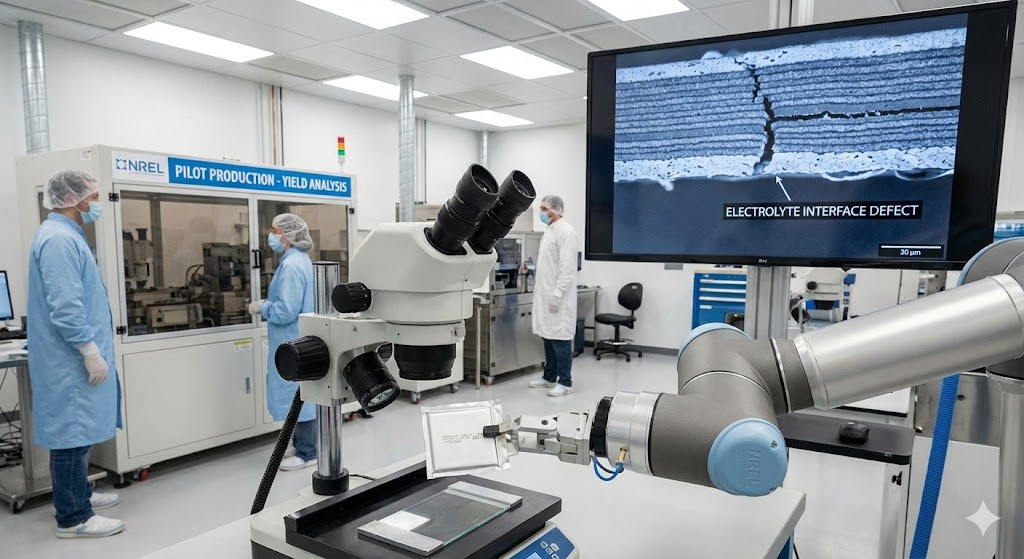
The promise of solid-state batteries—higher energy density, faster charging, and improved safety—has long captivated the energy sector. Yet, as the industry moves from benchtop prototypes to pilot production, the reality of manufacturing at scale is tempering expectations.
While solid-state technology offers a theoretical leap over traditional lithium-ion, the transition is hindered by low manufacturing yields and a lack of standardized testing for high-density materials. Success depends not just on chemical innovation, but on the ability to replicate lab-grade precision in high-volume environments.
Executive Summary
Current research at the National Renewable Energy Laboratory (NREL) emphasizes that while solid-state electrolytes can mitigate fire risks, the interface between the electrolyte and electrodes remains a primary point of failure. The Department of Energy (DOE) has launched utility-scale pilot programs to evaluate these systems in real-world grid applications, yet the path to cost-competitiveness remains unclear.
Key Evidence
Manufacturing data suggests that scaling solid-state production is significantly more complex than traditional battery assembly. According to IEEE Spectrum, the ramp-up of manufacturing facilities is often delayed by the need for specialized clean-room environments and precise pressure application during assembly. Furthermore, a study in Nature indicates that current yield rates for solid-state cells are significantly lower than those of liquid-electrolyte counterparts due to microscopic defects that propagate during the sintering process.
Standardization and Scaling
The National Institute of Standards and Technology (NIST) has identified a critical need for standardized metrics to evaluate high-density battery materials, as current protocols often fail to account for the unique mechanical stresses in solid-state systems. Research published in Science highlights that scaling metrics must move beyond energy density to include cycle life and thermal stability under industrial manufacturing conditions.
What changed recently
Recent pilot projects funded by the DOE are now testing solid-state integration at the utility level, providing the first large-scale data on long-term performance. Meanwhile, new yield analysis reports in Nature suggest that the industry is still struggling with defect rates that would be unacceptable in commercial consumer electronics.
What to watch next
- Development of dry-coating manufacturing techniques
- Solid-electrolyte interface (SEI) stability over 1,000+ cycles
- Impact of raw material supply chains on solid-state costs